

Mikala Schimke ’26, B.S. – Fashion Merchandising & Retailing has been enthralled with textiles and clothing all of her life. She shares why, after 18 years in a fashion merchandising career, she returned to school to complete her bachelor’s degree — and how JWU Online’s inclusive community helped her navigate neurodevelopmental challenges to make a career change.
Why She Loves Fashion
Schimke’s interest in fashion was influence by growing up in a “creative and cool but eccentric family.” Schimke’s grandfather is a playwright; her aunt Alex is a career fashion merchandiser who creates beautiful window displays for high-end department stores. Imprinted on Schimke’s memory is the image of Grandma Sally, always dressed in black from head to toe, her hair perfect, long red press-on nails on fingers holding Winston 100s and red lipstick left on a white coffee cup.
Schimke explains, “For years, when people asked what inspired my interest in fashion, I’d say, ‘Oh, I played with Barbies,’ because how could I explain to them that I remembered red lipstick on a white coffee cup. But that is one small piece of a childhood filled with colors, patterns, textures, and things that were tactile.”
Meticulous attention to detail and pattern recognition, together with sensitivity to color, texture and tactility is key to how Schimke experiences the world. Recently diagnosed with autism and ADHD (AuDHD), Schimke is neurodivergent.
“I’ve always loved clothes — not just purchasing them, but how they are made, what people are wearing and why. A lot of kids played dress-up with their parents’ clothing; I coordinated and paired patterns and prints. When you don’t have money to buy and wear different clothes, an easy way to connect with fashion is simply to learn about clothing.”
Why JWU Online
Schimke had worked with the same retail chain for 10 years when she considered enrolling in JWU Online’s Fashion Merchandising & Retailing bachelor’s degree program.
“Not having a degree felt like a brick wall for me,” Schimke says. “Mentors and corporate personnel cautioned that even with all my experience, it would be hard to break through to the corporate side without a degree.
“I was fortunate that my employer’s partnership with Guild Education would pay my tuition. JWU Online’s Fashion Merchandising & Retailing degree was the one fashion program on Guild’s list. I am not a person who settles, so I went to the website to learn about the school and its history.
“I wanted to attend a school in which students were not subject to prejudice, bullying or hate speech. There wasn’t a billboard about how diverse or inclusive the university is, but it was present in everything — the integrated learning classes, faculty profiles and in what leadership says — that JWU Online welcomes and supports all students.”
Evolving A Personal Learning Style In An Online Environment
Mid-way through her program, Schimke was diagnosed with AuDHD. “I grew up feeling like I hadn’t gotten a rule book that everyone else had. Once I started taking medication, I could breathe, walk, sleep, move and speak with ease and clarity. For the first time, I understood that how I had been walking through life wasn’t my fault.
“Allowing myself to accept how my brain worked completely changed my ability to get my work done, as did learning to advocate for myself by saying, ‘I need an extra day because it doesn’t work for me to complete this right now.’”
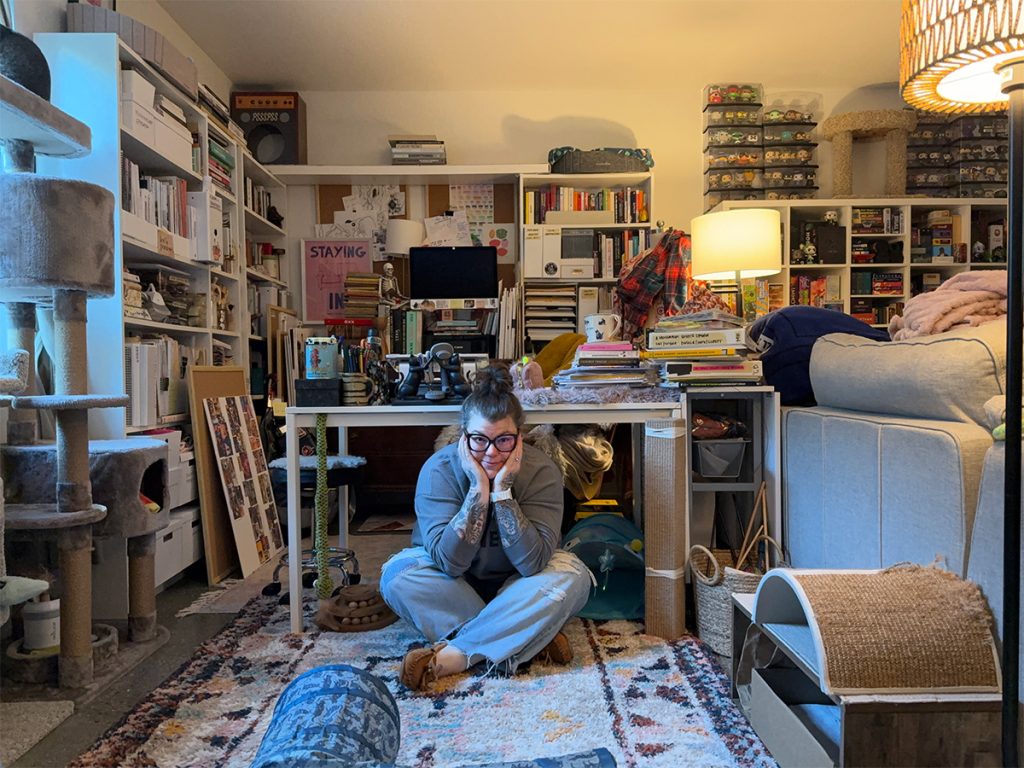
“At JWU Online, you show up for school every day in your own space and learn at your own pace.”
Schimke explains, “As a neurodivergent person, you have a sense of safety and security taking classes online that you can’t access in the classroom. You don’t have to feel everybody’s energy around you, and you have access to your creature comforts that make learning easier.
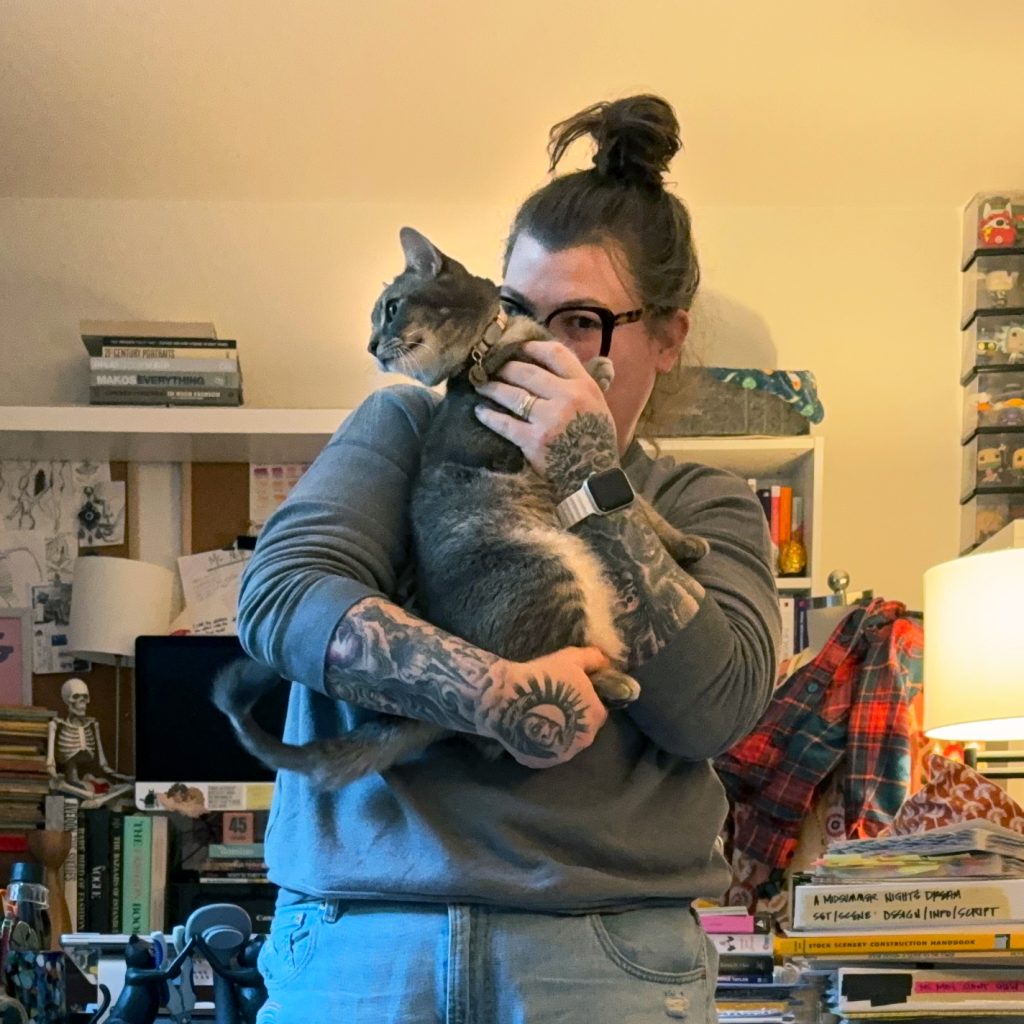
“It’s just you, your brain and the cool things you’re learning about in the space you created. For me, it’s the crazy, chaotic craft space in the corner of my apartment and the company of my cat, Houdini.”
The Fashion Merchandising & Retailing Program
Schimke remarks. “Focused on the business strategy and analytical side of global fashion, I felt like the curriculum was written for me. I was surprised at how well-crafted and simple the ulearn interface was for the online courses, making everything I needed accessible.
“I was able to connect every fashion-specific class in the well-rounded program back to one or more of my previous classes. There was not a single class that I didn’t find a way to utilize in my work.
“My academic advisor, Maureen Coutu, suggested balancing courses like statistics, macro and microeconomics by taking creative courses, in which I made mood boards, trend analysis boards and a color wheel, ensuring that I wasn’t overwhelmed by the math-heavy courses.
“Throughout my career, I had worked with an architectural ruler, drafting pencil and graph paper. Learning digital skills unlocked a new level of creativity for me. I built a whole floor plan digitally in PowerPoint with icons that represented the fixtures in a retail space.
“Fashion is constantly changing. Styles may come back around because fashion is cyclical, but what you are learning about the fashions of today won’t be relevant tomorrow. More important is that learning about the processes, procedures, general industry knowledge, industry terminology, vendors, sources and publications will all remain relevant.”
Acceptance From Faculty And Peers
Schimke enjoyed engaging in discussion posts with peers and supportive professors. “Access to so many voices, coming from different backgrounds and experiences, made online learning exciting.
“Having professors and peers who not only appreciated — but celebrated — how my brain works was very cool and eye-opening for me. Having had to mask my differences, I understand the importance of being in a community in which I feel accepted for who I am.”
Professors Met Her Learning Needs
Schimke praises the expertise of her professors.
“Professor Sarah Jablon Roberts, who taught me about textiles, is a fashion educator, costume designer and researcher. She was an incredible resource for how the physical world of textiles can be assessed digitally. As a buyer, you won’t be able to physically get your hands on everything you’re working with. You’ll need to know how to assess a fiber, fabric, or textile digitally through a lens and a computer or over Zoom.”
Pat Fisher was a mentor for Schimke.
“Professor Fisher leaned heavily on assigning hands-on projects. She never commented on how I perceived things differently from other students. Her feedback was about the structure or the missing elements in the work I produced. She’d say, ‘It would have been great to see XYZ in this. Or I love this, but it would have been awesome if you had included two more outfits.’
“In every course I took from Professor Fisher, she remembered how I needed to learn and receive feedback. Every assignment got better, and every class I had with other instructors afterwards got better, because I was able to take her feedback and apply it in other ways.”
Communication courses are essential for working in fashion.
“The Rhetoric & Composition course taught by Professor Eileen Medeiros was perfect for reviewing fashion shows, where you are describing entire collections, viewed on runway models at about 30 seconds per garment.
“I could navigate Professor Christopher Westgate’s public speaking class online in ways I could not have done in a classroom. It’s super hard for me to record a speech without constantly referring to my notes, and to stay within a time limit. At home, I could record the speech as many times as needed until I was happy with it.
“Professor Westgate offered valuable feedback about the structure of my speeches and tips to appear at ease, like holding a pen or keeping my hands at my sides to calm the hand motions I make when I get excited. Because his critique wasn’t personal, I walked away from each one of those speeches feeling accomplished.”
Changing Perspective
For years in the fashion industry, Schimke focused on climbing the ladder to achieve success in her career. Feeling happy was at the bottom of her list.
“I thought that after I achieved X, Y and Z, I would be happy, but every rung of the ladder that I had painstakingly climbed wasn’t bringing me happiness — I was just hanging on for dear life.
“I ended up with severe burnout. I needed to create space for exploring myself and to figure out what I wanted in my life. Ultimately, I took a leap of faith and left my job.
“Leaving a job without having other work lined up was scary. I had to figure out how I would pay tuition on my own for my last year in school. I feel fortunate for Derrick, my wonderful partner of 20 years — with whom I have been married for 10 years. He told me we’d figure it out, and we did.
“My advisor Maureen and my financial planner, Marybeth Dempsey, were rock solid for me throughout my time at JWU. Together, they helped me create a payment plan so I could pay the tuition in full as I completed the program.”
Finding Her Way Back To Fashion Retail
A few months after leaving her long-term job, Schimke felt the need to ‘do something.’
“I’d always dreamed of working for the clothing and lifestyle store, Anthropologie, so I applied and was hired as a part-time, seasonal sales associate. After the season ended, I was asked to stay on, and I was recently promoted to a Back of House Specialist. Shifting gears after spending so many years in leadership and management has been an adventure, but ultimately I love retail.”
Schimke may move up the ladder again, but her perspective has shifted.
“I’ve made plenty of space for all the things that I still need to work through and discover about myself. I realize now that I don’t need to climb anything because I’ve put my happiness first — it’s the foundation upon which I’m building everything.”
A New Direction
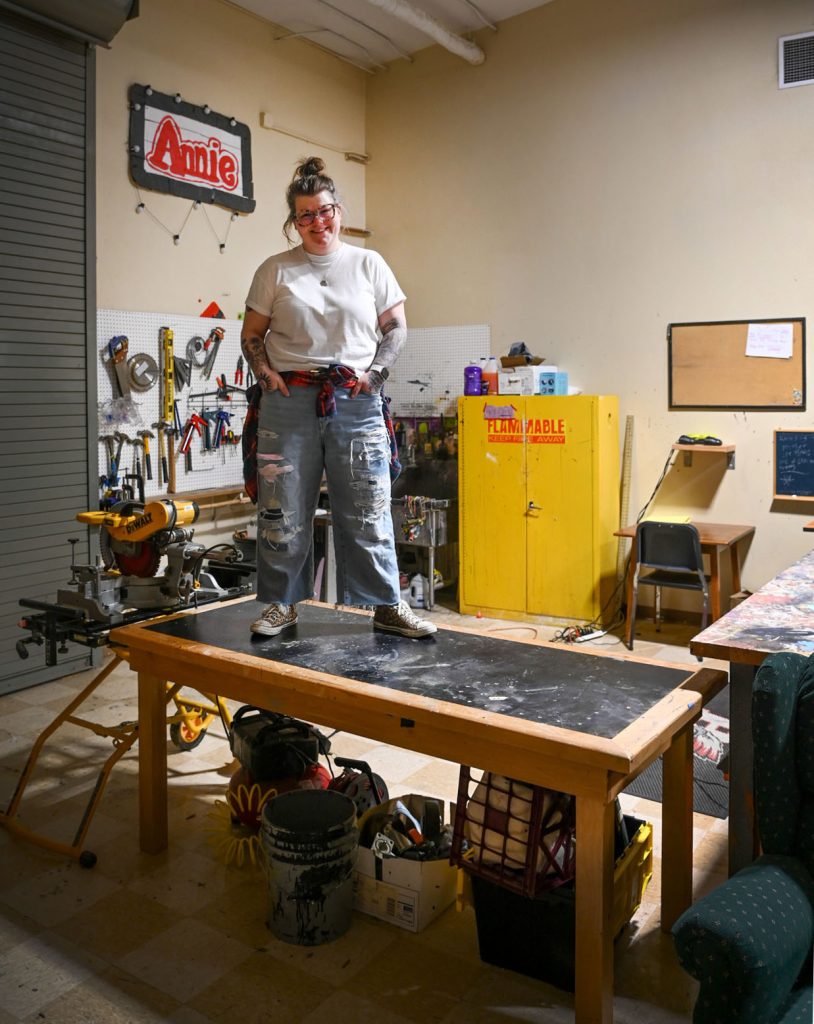
“Taking a sharp left turn, I ended up volunteering at the Pleasant Grove High School Theater Company. We produced Annie last year, are now preparing for A Midsummer Night’s Dream and plan to present Legally Blonde next summer.
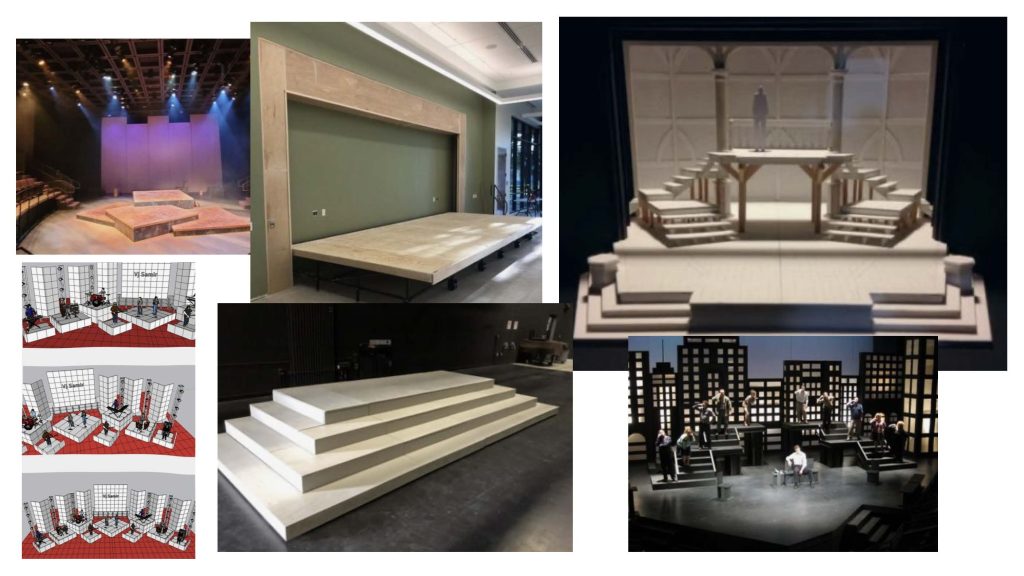
“I’m using my 20 years of space planning to help with set design and transferring my experience in merchandising to support design concepts and stagecraft. My knowledge of how to build displays is helping the company construct pieces — and my love of fashion translates into costume concepts and design.”
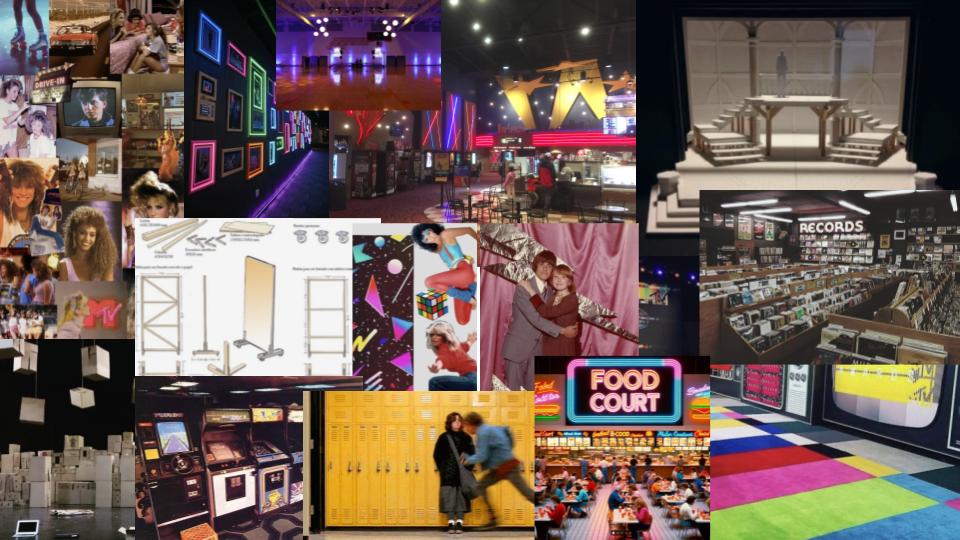
Schimke took on the role of creative designer after the director asked for an alternative to setting A Midsummer Night’s Dream in the woods.
Schimke proposed, “Think about a teenage jungle — the play will be an adaptation of high school students in Athens set in the 1980s. The teenage jungle in the eighties was the mall. Using digital skills learned in the program, instead of drafting the concept on paper, I busted out an entire concept in one night that we are now designing.
“I enjoy being at the theatre and working with the students. The decision to volunteer allows me to set boundaries on my energy and my time. And the time and energy I do contribute is fully respected by the director, the costumer and the other creative partner volunteers.”
Stepping Forward
“JWU Online has filled my toolbox to the brim with valuable insights and problem-solving skills. Being surrounded by others at JWU Online who loved learning about fashion merchandising and retailing was incredible. We all came together in that space and learned from one another in ways that in-person classes wouldn’t provide.
“The journey has been hard, but my professors and peers have helped me find more strength, stability and pride in myself than I had ever felt in my career. I truly believe that without JWU Online and the professors that challenged me, it would have taken a lot longer to find and trust myself to take risks.
“I’m taking a break now, but when I’m ready to earn a master’s degree, I will return to JWU Online!”
Is A Career In Fashion Your Passions?
According to BLS.gov, employment for Purchasing Managers, Buyers, and Purchasing Agents between 2025 – 2035 is projected to grow 6%. For more information about the B.S. Fashion Merchandising and Retailing program, complete the request information form, submit your free application or email [email protected].