

With Dr. Rex Warren, DBA Program Director
Johnson & Wales University’s fully online Doctor of Business Administration (DBA) programs are designed for working professionals who want to apply doctoral-level research directly to real challenges in their organizations and industries.
“If you already lead people, solve complex problems and want a terminal business degree you can use immediately — not someday — JWU’s online DBA is built for you.”

With specialized concentrations in Organizational Development and Hospitality Leadership, students can align their studies with their career goals while benefiting from JWU’s strong business and hospitality foundation. Both share the same core curriculum involving strategy, leadership, analytics, research methods and executive decision-making. However, each concentration delves into industry-specific issues and is designed to develop leaders in those fields.

Organizational Development
The Organizational Development concentration is ideal for mid- to senior-level leaders who are already responsible for people, culture or change, and who want to lead that work at a higher level. This concentration fits professionals who:
- Manage teams, departments or enterprise initiatives and need a more rigorous way to diagnose problems and design interventions.
- Are asked to lead transformation, culture work, restructuring or large-scale change.
- Want to become more adept at aligning strategy, people, systems and metrics.
- Work in business, healthcare, government, the military, higher education, consulting or nonprofits.
Hospitality Leadership
The Hospitality Leadership concentration is designed for leaders in hospitality or hospitality-adjacent fields who already manage people and operations who want to move into executive roles. Drawing on JWU’s 50+ years of experience developing hospitality leaders, this concentration is built around the realities of hospitality leadership today: labor pressure, guest expectations, technology, sustainability and complex growth decisions.
This concentration fits professionals who:
- Work in hotels, restaurants, events, tourism, foodservice, private clubs, casinos or related guest-experience businesses.
- Lead talent, operations, growth, innovation or multi-unit strategy.
- Need stronger command of people strategy, sustainability, technology, crisis planning, real estate, mergers and acquisitions and reputation management.

DBA Dissertation Process
JWU uses a lockstep, mentored dissertation model. The program is designed for three-year completion, with a five-year maximum. The intent of the lockstep model is to make on-time completion realistic for working professionals, with the dissertation addressing an authentic problem in the student’s industry or organization. The dissertation process is built into the curriculum with checkpoints, courses and a committee.
Years 1 & 2
The first two years focus on research design, quantitative methods, qualitative methods and the business core. Students are encouraged to identify a dissertation topic early and use coursework to develop the literature and problem statement.
Near the end of Year 2, students complete a prospectus that outlines the problem, supporting literature and proposed methods.
Year 3
Year 3 begins the official dissertation sequence. Students write a formal proposal covering the problem, purpose, research questions, literature, methodology and planned contribution to practice.
After proposal approval, students complete required ethics training and seek Institutional Review Board approval before collecting data. Students then move through research, analysis, findings and recommendations in structured dissertation terms, with regular advisor feedback.
The oral defense is conducted remotely. The committee includes a JWU major advisor, a program methodologist and a second reader. Students may invite guests if they wish. Upon completion of a successful defense and any required revisions, the dissertation is finalized and published through the JWU Scholars Archive and ProQuest.
“Researching and writing a dissertation has been a great learning experience, from which I have grown tremendously. More than just earning the degree, you build character and resiliency. The DBA program prepares you to more easily deal with complex business problems and to navigate through uncertainty without becoming overwhelmed. You become a better person and a better leader.” – Stephen Senteio, ’23 DBA
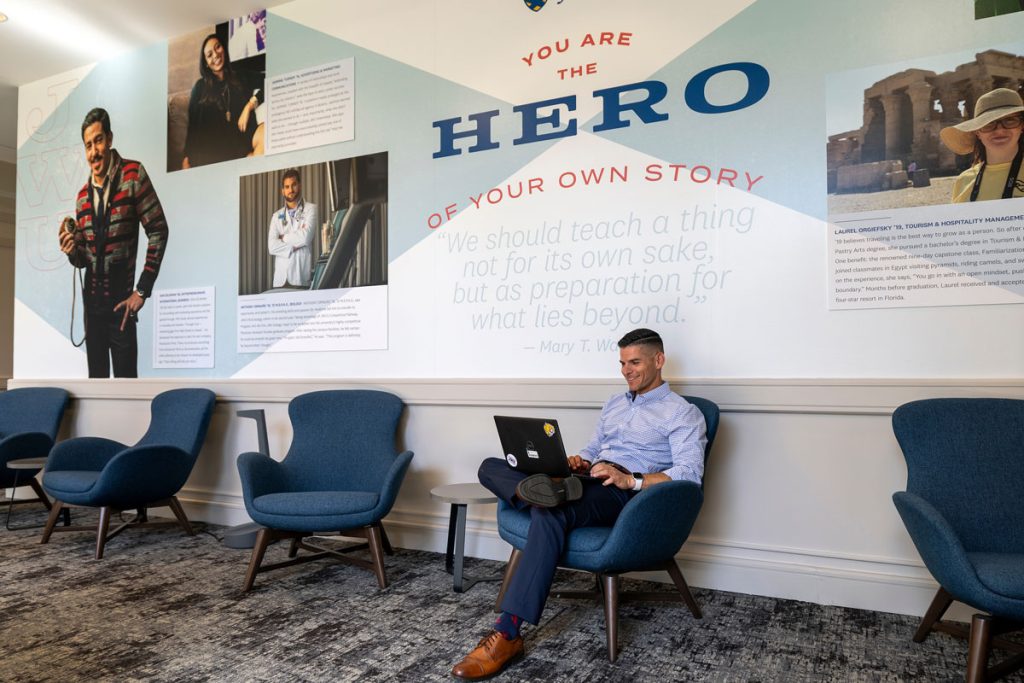
Graduates of the program can advance into executive, organizational development and hospitality leadership roles, as well as consulting, higher education, public service and thought leadership.
“Beyond achieving my life-long dream of earning a terminal degree, the DBA degree aligns with my career path as a data analyst and AI specialist. The knowledge I’ve gained in the DBA program will help me advance to the executive level—possibly to vice president or further.” – Dr. Suzannah Hicks, ’24 DBA
Support For Students
Support for doctoral students begins before the first class and continues through dissertation defense. Doctoral students can take advantage of:
- Dedicated academic advising: Students are assigned a dedicated academic advisor who serves as the main point of contact for course registration, pacing and guidance to remain on track.
- Faculty mentoring: DBA faculty are industry-experienced and guide students through the dissertation as major advisors, methodologists and committee members.
- 24/7 tutoring: Online students can access professional tutoring around the clock through Tutor.com.
- Writing support: JWU Online writing specialists help students with drafting, organization, research writing, revisions and citation, from course papers to dissertation writing.
At JWU Online, you’re never doing it alone. Learn more about the support services offered to students.

Admissions And Enrollment Process
New JWU doctoral students enroll in August for the fall semester and May for summer semester, with deadlines approximately a month before the start date. Interested students should begin the admissions process early, as cohorts are limited.
Just like the support current students receive, prospective students receive dedicated support from Admissions Associate Sarah Delisle. “I am the student’s first point of contact throughout the application process for any admissions or program-related questions and remain the point of contact until their 2nd week of the first semester,” she notes.
After students complete JWU’s free online application, they can expect an email and phone call from Delisle within two business days to review their professional goals, the program and to discuss personalized next steps.
Students are required to submit:
- Bachelor’s and master’s degree transcripts
- Two letters of recommendation (at least one professional)
- A résumé highlighting direct people-management experience
- A statement of purpose
Qualified applicants will then complete a Zoom interview with the DBA Committee. Once accepted, Delisle will provide information on JWU account setups, orientation, course registration and program preparation.

Getting Started
Ready to strengthen your leadership impact with research you can apply to real-world business challenges? Take the next step toward a JWU Online DBA by submitting your free online application or requesting more information to connect with our team and learn which concentration best supports your goals.