
Good marketing creates visibility. Great marketing communicates how a product or service meets customers’ needs to build perceived value. Exceptional marketing tailors messaging and communication to each customer’s place in the marketing funnel, ensuring the timing of the messaging they receive maximizes advertising impact. To leverage the marketing funnel in an advertising campaign, marketers first strive to understand their potential customers, their pain points, the customer journey and the customer experience to deploy high-powered marketing tactics that can maximize conversions.
Read on to explore the marketing funnel, discover powerful marketing metrics to track and consider a few actionable strategies to improve marketing performance.
What Is a Marketing Funnel?
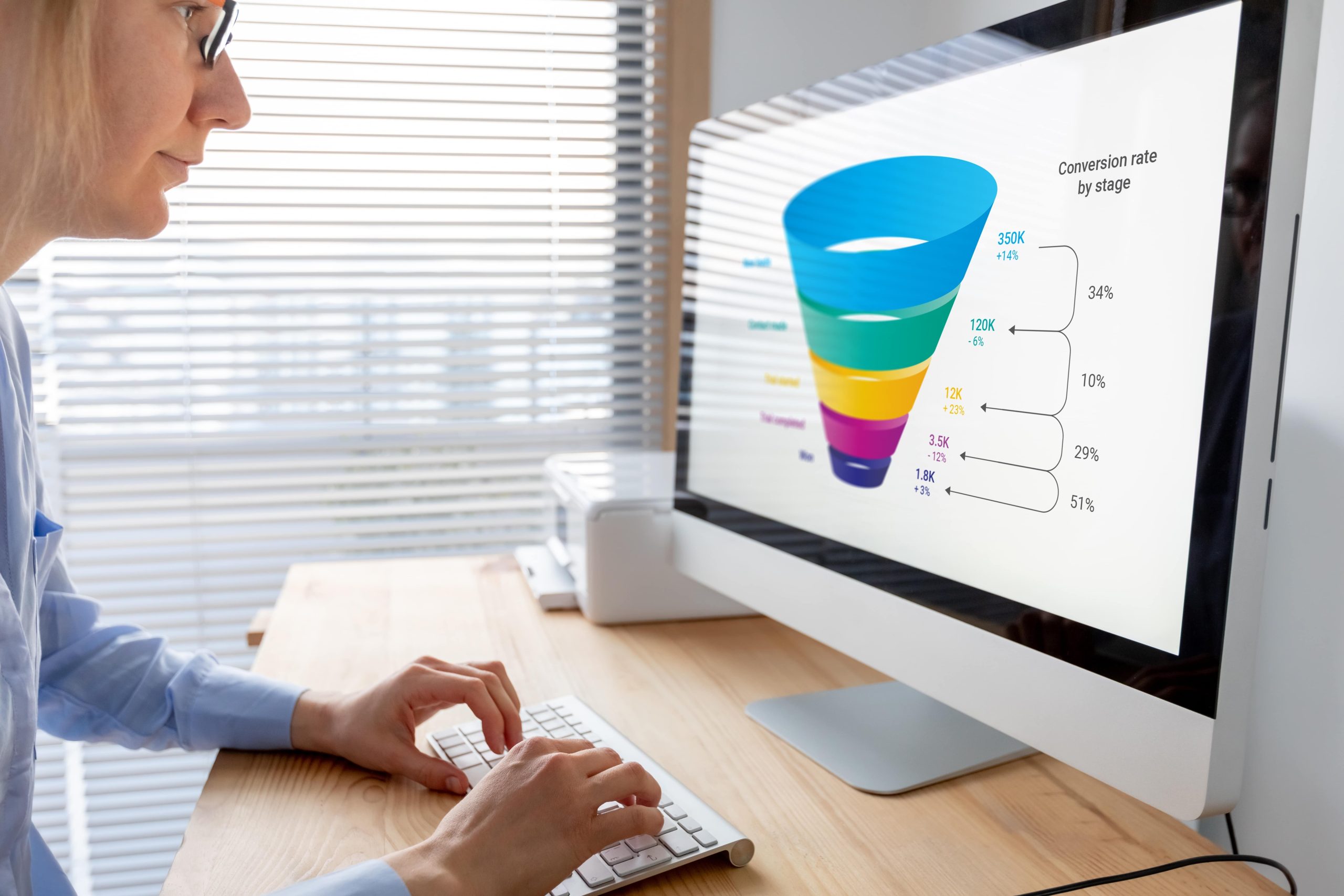
A marketing funnel is a funnel or upside-down-cone-shaped model that visually represents the journey a customer takes from initial brand awareness (or product awareness) to conversion (purchase) and brand loyalty (repeat purchase). Understanding this enables marketers to devise and implement custom-designed strategies for each stage of the marketing funnel — making messaging feel more personal to customers and resulting in more effective communication.
For example, customers at the wider top of the funnel represent a broader audience that receives surface-level advertising. Customers closer to the narrow bottom of the funnel receive more specific, targeted advertising.
Marketing Funnel vs. Sales Funnel vs. Content Marketing Funnel
The terms marketing funnel, sales funnel and content marketing funnel describe different (though overlapping) parts of the customer journey.
- The marketing funnel is the broadest of the three. It encompasses the entire journey — from the moment a prospect first becomes aware of a brand, all the way through purchase and retention. It organizes messaging across every stage, guiding a wide audience at the top toward conversion and loyalty at the bottom.
- The sales funnel refers specifically to the lower stages of that larger journey. It picks up where marketing hands off qualified leads and focuses on converting sales-qualified leads (SQLs) into paying customers through tactics like product demos, consultations and closing offers. In short, the sales funnel is a subset of the marketing funnel, concentrated on the point of conversion.
- The content marketing funnel describes how content (e.g., blog posts, videos, e-books, webinars and email campaigns) supports prospects at each stage of the broader marketing funnel. Rather than the customer journey itself, it maps the type of content best suited to move someone from one stage to the next. Educational, top-of-funnel content builds awareness; comparison-focused content aids consideration; and testimonials or case studies help drive decisions near the bottom.
| Funnel Type | Scope | Primary Owner | Goal |
|---|---|---|---|
| Marketing Funnel | All six stages, from awareness to loyalty | Marketing | Build awareness and nurture leads |
| Sales Funnel | Bottom stages only, from SQL to purchase | Sales | Close the deal |
| Content Marketing Funnel | Content strategy across all stages | Marketing/Content | Support every stage with the right content |
Benefits of a Marketing Funnel
If you understand the difference between saying, “Nice to meet you,” instead of, “Nice to see you,” to someone you have already met, then you’re already beginning to grasp the importance of a marketing funnel.
Beyond letting customers know you remember them, a marketing funnel helps a business strengthen its marketing strategy, customer relationships and return on investment (ROI) by organizing messaging and marketing campaigns into stages. Marketing funnels accompany several benefits:
- Guide prospects effectively. Using a marketing funnel to map the customer journey and inform a marketing strategy facilitates the attraction of a broad audience at the top of the funnel while progressively narrowing it down to purchasers at the bottom with strategically targeted messaging. The marketing funnel attracts a large group of prospects and systematically guides them through each step of the purchasing process, providing slightly greater detail, more information and increasingly more valuable content at each step.
- Increase conversions. Businesses that leverage marketing funnels may increase conversions by nurturing leads, identifying and eliminating bottlenecks, enhancing customer understanding and establishing authority and cultivating trust.
- Optimize marketing spend. A marketing funnel also helps businesses increase the ROI on their marketing spend by ensuring the right customers see the right ads at the right stage of the funnel (thus increasing marketing-related conversions).
- Build long-term relationships. Tailored content helps existing customers feel recognized, valued and understood. When a business targets the bottom of the funnel with community-building efforts and loyalty rewards, the marketing funnel ensures a business tells returning customers, “Nice to see you again,” making them feel appreciated while building trust and loyalty.
Types of Marketing Funnels
While every marketing funnel shares the same basic goal — guiding prospects from awareness to conversion — funnels take different shapes depending on the channels used, the content deployed and the type of customer being reached. Below are several common types:
Digital and Online Marketing Funnels
Digital and online marketing funnels map the customer journey across digital channels such as search engines, social media, paid advertising and email. Because online behavior is highly trackable, these funnels give marketers rich data at every stage — from impressions and click-through rates at the top to conversion rates and customer acquisition costs at the bottom. Tactics are coordinated to move prospects smoothly from a first click to a completed purchase, typically including:
- SEO-driven content
- Retargeting ads
- Landing pages
- Automated email sequences
The measurability of digital funnels makes them especially useful for A/B testing and data-driven optimization.
Content Marketing Funnels
A content marketing funnel focuses on using valuable, relevant content to attract, nurture and convert prospects at each stage of the journey. The goal is to meet the audience with the right information at the right moment, building trust and authority along the way.
- At the top of the funnel, content aims to build awareness and answer broad questions; think blog articles, how-to guides and social media posts.
- In the middle, content shifts toward consideration, offering comparison guides, webinars and case studies that help prospects evaluate their options.
- Near the bottom, content becomes more conversion-focused, with product demos, customer testimonials and free trials.
B2B vs. B2C Marketing Funnels
Business-to-business (B2B) and business-to-consumer (B2C) funnels reflect the different ways organizations and individual consumers make purchasing decisions.
- B2B funnels tend to be longer and more complex. Purchases frequently involve multiple decision-makers, larger budgets and extended sales cycles. Thus, these funnels emphasize relationship-building, lead nurturing and educational content like whitepapers, demos and consultations. The distinction between marketing qualified leads (MQLs) and sales-qualified leads (SQLs) is especially noteworthy here, as sales teams typically play a hands-on role near the bottom of the funnel.
- B2C funnels are generally shorter and more emotionally driven. Consumers often move from awareness to purchase quickly — sometimes within a single session — so these funnels prioritize broad reach, brand appeal and frictionless conversion. Tactics like social media advertising, influencer partnerships, limited-time offers and loyalty programs help capture attention and encourage fast decisions.
6 Stages of a Marketing Funnel
The basic marketing funnel includes six basic stages. From top to bottom, they (and their respective target audience) are as follows:
1. Awareness Stage (Top of the Funnel — TOFU)
In the awareness stage, prospects first become aware of a business, brand, product, or service. The prospect is a visitor.
- Goals – Attract as many prospects as possible to enter the funnel at this stage by making them aware of your brand, product, business, or service.
- Tactics – Businesses cast a wide net to attract prospects to the awareness stage using tactics like SEO-driven content marketing strategies, social media advertising, paid advertisements, and influencer partnerships.
- Example – An example of awareness stage marketing could be placing a billboard for a home security company in a neighborhood with a high break-in rate.
2. Interest Stage (Middle of the Funnel — MOFU)
In the interest stage, a prospect demonstrates interest in a product or service with an initial engagement. The visitor becomes a lead.
- Goals – Encourage further engagement and provide more information about the product or service.
- Tactics – At this stage, vendors share pricing information and use lead magnets (such as discount offers, free e-books, or free templates) to collect contact information and initiate an email marketing campaign. Businesses might deliver additional information with video explainers and begin building trust with social proof tactics (i.e., industry awards, testimonials, and customer reviews).
- Example – A skincare brand could prompt a website visitor to take a quiz for product recommendations and then require an email address to deliver the results.
3. Consideration Stage (Middle of the Funnel — MOFU)
A lead begins considering your product or service and comparing it to that of the competition. The lead becomes a marketing qualified lead (MQL).
- Goals – Use a targeted marketing strategy that focuses on differentiating from the competition to position the business as the best solution.
- Tactics – In the consideration stage, businesses can leverage marketing tactics like product demos, webinars, comparison guides, and case studies.
- Example – A business could present a product comparison chart that highlights all of their product’s features and benefits while showing where the competition’s similar product is lacking.
4. Intent Stage (Bottom of the Funnel – BOFU)
In the intent stage, the funnel narrows considerably, and the likelihood of converting the remaining MQLs increases significantly when sales-qualified leads interact with the business, looking for more information or expressing intent to purchase. The MQL becomes a sales-qualified lead (SQL).
- Goals – Convince or inspire SQLs to convert to customers.
- Tactics – When a customer expresses intent, businesses can entice them to convert by offering free trials, using retargeting ads, including clear calls to action in their messaging, and providing easy-access FAQs.
- Example – An accounting software developer could offer a 30-day free trial to SQLs in the hope that they will rollover the service and become paid subscribers at the end of the month.
5. Action Stage (Bottom of the Funnel – BOFU)
After a successful intent stage, an SQL becomes an opportunity in the action stage, as they finalize their decision regarding whether or not to purchase. The SQL becomes an opportunity.
- Goals – Persuade opportunities to purchase.
- Tactics – Businesses can use strategies like customer testimonials, transparent pricing, guarantees, and sales consultations to help opportunities convert to customers.
- Example – A company selling cleaning products could offer a money-back satisfaction guarantee to help convert customers with remaining doubts about the product’s effectiveness.
6. Purchase and Retention Stage (Bottom of the Funnel – BOFU)
The bottom of the sales funnel is where the opportunity is converted into a customer. This stage holds all of a business’s customers after they decide to make an initial purchase.
- Goals – Maximize customer satisfaction and retention.
- Tactics – Businesses can use strategies like onboarding emails with thank-you messaging, loyalty campaigns, and strategically timed upsell offers.
- Example – Loyalty programs, especially in retail businesses, improve customer retention. Customers earn points with each purchase that can be applied as discounts to future purchases. As a result, a customer choosing between similar products sold by different businesses will be less likely to forfeit their points and switch to a competitor’s store to purchase the same product.
Marketing Funnel Metrics and KPIs to Track
Funnel-shaped or not, a marketing strategy isn’t complete without a plan to track metrics and measure performance. To effectively evaluate the efficacy and ROI of marketing funnel strategies, businesses will ideally measure performance at every stage, using different key performance indicators (KPIs) for each.
When selecting KPIs, you will have virtually endless options — so pick those that align with your business’s specific marketing goals.
Traffic and Awareness Metrics
These metrics help businesses measure how many prospects are included in the top stage of the marketing funnel. They include data like:
- Impressions
- Reach
- Website visitors
- Page views
- Sessions
- Time on site
- Brand mentions
- Branded search volume
- Share of voice
- Social media engagement
- Direct traffic
Engagement Metrics
Engagement metrics attempt to measure an audience’s active interaction with your content or brand, helping you evaluate the audience’s interest and the effectiveness of the content. This data can be examined during any stage of the marketing funnel, but is particularly relevant during the interest and consideration stages, when a customer’s engagement is key to future conversion.
Examples of engagement metrics include:
- Engagement rate (views, clicks, interactions, etc.)
- Social media engagement (i.e., reactions, comments, and shares)
- Click-through rate
Lead Generation Metrics
These metrics evaluate lead generation, cost, and effectiveness. Some examples include:
- Number of leads generated
- Conversion rate
- Cost per lead
- Lead quality
- Lead source performance
Conversion Metrics
Conversion metrics help businesses assess how effectively they transform leads into customers. Some useful KPIs include:
- Lead-to-customer conversion rate
- Customer acquisition costs
- Time to conversion
Retention and Loyalty Metrics
Once a business acquires customers, they become valuable assets — as long as they can be retained and remain loyal. Tracking customer retention and loyalty metrics can help a business assess how well it holds onto its converted leads. Some useful KPIs include:
- Customer retention rate
- Customer lifetime value
- Repeat purchase rate
- Customer churn rate – The percentage of customers who stop buying from a company over a set period.
- Customer satisfaction score
- Net promoter score – Measures how likely customers are to recommend a brand to others.
- Redemption rate – Tracks how often customers redeem offers or rewards.
- Time between purchases
Advanced Tactics to Optimize Your Marketing Funnel
To create a funnel-based marketing strategy, businesses conduct research to understand various customer personas and the customer journey in detail. In some cases, organizations build their funnels backwards by carefully studying the customers that populate the bottom of their marketing funnels, which helps them understand the types of prospects that are most likely to be converted.
Businesses should seek to understand the kind of messaging that will be most valuable at each stage. They then need systems in place to support the marketing funnel strategy, deliver targeted messaging, gather data, and support prospects as they work their way toward becoming loyal customers.
Various modern marketing tools and technologies can help automate the processes necessary for executing a funnel-based marketing strategy. This includes options like:
- Artificial intelligence (AI)-powered personalization
- Omnichannel integration
- Customer relationship management (CRM) systems
- A/B testing
- Data-driven optimization
FAQs About Marketing Funnels
From top to bottom, the six main stages of the marketing funnel are awareness, interest, consideration, intent, action, and purchase/retention.
Marketing funnels are an essential element for businesses because they optimize marketing strategies — tailoring tactics to each stage of the sales funnel — to increase customer conversions, improve marketing ROI, and promote customer retention.
For the best results, select a variety of metrics regarding traffic and awareness, engagement, lead generation, conversion, and retention and loyalty that align with your business’s individual marketing goals.
A marketing funnel encompasses six stages from top to middle to bottom, or beginning to end. The sales funnel refers only to the lower stages of the funnel, focused on converting sales-qualified leads (SQLs) into customers.
A digital marketing funnel follows the same six stages as a traditional marketing funnel, but each stage plays out through online channels instead of offline ones. Awareness might come from paid search or social media ads rather than a billboard or print ad; consideration might involve a webinar or downloadable guide instead of an in-person demo. The stages and goals stay the same — only the tactics and ability to track each step in real time change.
Several mistakes show up most often. Avoiding them comes down to giving every stage of the funnel (not just the top) clear goals, tactics and a way to measure whether it’s working.
First, over-investing in the awareness stage while neglecting the middle and bottom of the funnel fills the top with prospects who never get nurtured toward a purchase. Second, poor lead qualification lets unqualified leads flow through the funnel, wasting time and resources that could go toward prospects more likely to convert. Lastly, weak follow-up after initial interest lets warm leads go cold.
Mastering Your Marketing Funnel
Marketing professionals who master the marketing funnel — continuously using KPIs to improve their strategies — reach more prospects, generate more leads, and develop stronger relationships with converted customers for overall greater success in marketing campaigns.
Become a Marketing Funnel Wizard With Johnson & Wales University
At JWU Online, we offer flexible options for students to study online while earning a Bachelor of Science in Marketing & Advertising. Following this degree path, students have the opportunity to explore and learn the foundational skills and concepts of marketing and advertising — like customer personas, customer journey maps, and marketing funnels — while applying what they learn to experiential learning assignments.
For more information about completing your degree online, complete the Request Info form, call 855-JWU-1881 or email [email protected].